
Automatically finding the best optical channels
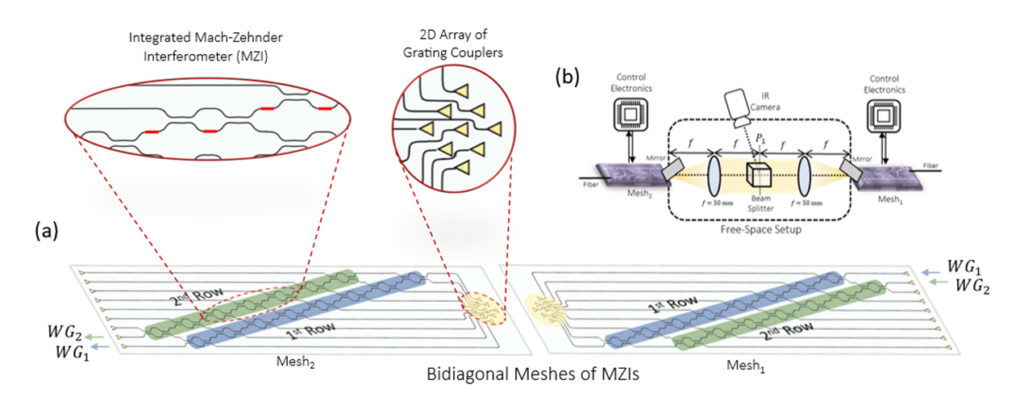
We can find the best orthogonal and independent channels through any linear optical system using meshes of Mach-Zehnder interferometers at both the “transmitter” and “receiver” ends of the system just by maximizing powers. We simply adjust the phase shifters in interferometers in the 1st row on both sides to maximize the transmitted power from waveguide WG1 at the input to the corresponding waveguide WG1 at the output at the other side to find the first and best-coupled channel. Then we repeat this in the 2nd row with waveguides WG2 to find the second-best-coupled channel, which will be orthogonal to the first channel (so with zero cross-talk in principle). This could be extended to more channels by adding more mesh rows. Note that it is the optics that does all the “calculations” in this optimization. Control electronics just runs the optimization algorithm. So, in a sense, this is a true “optical computer”. Note too that this system can automatically compensate for any scattering or other optics inserted in the path, still finding the best-coupled and orthogonal channels.
S. SeyedinNavadeh, M. Milanizadeh, F. Zanetto, G. Ferrari, M. Sampietro, M. Sorel, D. A. B. Miller, A. Melloni, and F. Morichetti, “Determining the optimal communication channels of arbitrary optical systems using integrated photonic processors,” Nat. Photon. 18, 149-155 (2024) https://doi.org/10.1038/s41566-023-01330-w Supplementary material