
Modern Physics for Engineers and Scientists book
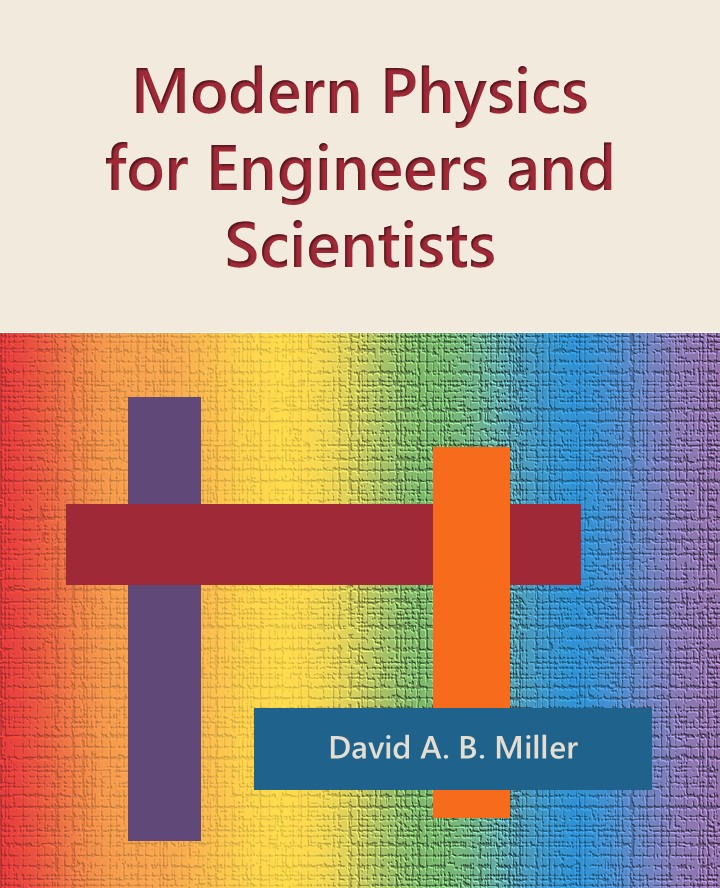
This book introduces the modern physics of quantum mechanics and statistical mechanics and their applications. Its approach makes it accessible to a wide range of scientists and engineers. Openly available online videos cover the entire material of the text chapters. A digital version of the book, including links to all videos, is freely available; paper versions are also available. Extensive problems and many solutions are provided, making the book suitable both for classroom teaching and individual study.
Introduction
The physical technologies we need for major societal goals, from solar energy to the ways we sense, move, store and process information and design modern materials and devices, are based on ideas and concepts beyond the world of classical physics. A purely classical view gives us no model for the atoms and molecules of chemistry or of material properties such as color or electrical conductivity. We cannot understand the simplest solar cell or even the color and brightness of the sun. To move forward, we need core ideas from quantum mechanics and statistical mechanics, but introducing them often requires multiple courses and textbooks, creating a barrier for a broad range of engineers and scientists to learn these central and powerful ideas. This book introduces all these topics, economically yet rigorously, in one coherent approach suitable for engineers and scientists from a broad range of disciplines. It is well suited both for classroom use and individual study. A large number of quiz questions and problems and solutions are provided. Openly available online lectures are carefully sequenced and linked with the entire main text.
Who this book is for
The intent of this book is to introduce these key ideas of modern physics to anyone with a moderate college science or engineering background. This book has been designed both as a classroom text and as a good way for any such interested student to learn this material themselves.
The material is at a level accessible for students studying science or engineering from second year college or beyond, and could be suitable also for a well-prepared first-year student. The title “Modern Physics for Engineers and Scientists” is chosen in part to reassure engineers and scientists outside of physics who might otherwise be (or already have been) discouraged from such a topic. The material is, however, suitable for scientists and engineers in many fields, including physics itself.
The main adjustments compared to some standard physics sequences are, first, that the material deliberately minimizes the required physics to start the course and, second, that the material is introduced in the order that makes most intellectual sense, rather than in historical sequence. As a course, it is intended to be particularly economical and efficient in introducing its core topics of quantum mechanics and statistical mechanics, hence allowing it to be included in a syllabus of courses that will have many other demands on student learning time.
Teaching and learning approaches
The material is sufficient for a full “quarter” (e.g., 10 week at ~ 3 lectures per week) course, or, at a more relaxed pace, a “semester” (e.g., 15 week at ~ 2 lectures per week) course. As such, it can form the basis for a conventional lecture course, for which more than sufficient problems are included for weekly problem sets throughout the course.
Sequence of topics
The material is presented in a coherent sequence.
1) A short background history of physical science up to about 1860 (Chapter 1)
2) Background physics and mathematics (Chapter 2)
3) An introduction to quantum mechanics (Chapter 3) and its use to understand atoms and crystalline materials (Chapter 4)
4) An introduction to statistical mechanics, how it underpins key thermodynamic ideas, and how it gives thermal statistical distributions of particles like electrons and photons (Chapter 5).
5) Use of the quantum mechanics and statistical mechanics to understand the physics of electronic devices (Chapter 6). Appendix C also extends this discussion for those particularly interested in this topic.
6) The basic quantum mechanics of light, including thermal radiation and absorption and emission (Chapter 7).
7) The use of these ideas for understanding semiconductor optoelectronic devices (Chapter 8).
Using parts of this sequence
Parts of this sequence can be used on their own, and some topics can be omitted. Chapters 3 and 4 (supported by Chapter 2) give a solid first introduction to quantum mechanics. Chapter 5 can be used on its own as a first introduction to statistical mechanics. If the material in Chapters 2-5 is covered, Chapter 6 (and optionally Appendix C) can be used for understanding electronic device physics. Again following Chapters 2-5, Chapter 7 can introduce the quantum and statistical mechanics of optics and optionally Chapter 8 can introduce optoelectronic device physics.
Special features of this book
The material has three additional features – quiz questions, selected problem solutions, and online videos – that can help in class-room teaching or with other or extended ways of learning.
For students studying on their own, hopefully these three features make it easier to work through the course, in whatever style the student prefers. These features can also be useful in “flipped classroom” teaching approaches that emphasize the use of class time for problem solving and discussion. The students could, for example, watch the online videos before the class session. Class time could also make use of the quiz questions to stimulate discussion (possibly with “closed books”), or go one to solve some of the problems.
Quiz questions
In the book itself, there are extensive “quiz” questions at the end of most sections. These quiz questions require little or no calculation or algebra to answer, so should take little time. Rather, they allow the student to test and exercise their conceptual understanding of the material just presented. Importantly, all answers to these questions are provided.
Solutions to selected problems
Full solutions to selected problems are provided in the book. This will be especially useful for students studying the material on their own, and can be an additional resource in class-room teaching, providing worked examples.
Online lectures
There is a complete set of 25 online lectures, all openly available, that present all the material in the main text, in order. These lecture videos are presented in multiple shorter sections better matched to concentration spans.
An icon, such as , shows the point in the text corresponding to the start of each numbered lecture section. These icons are live in the digital version of the text, and clicking on them will bring up the lecture video. The lectures are also relatively self-contained in covering the material.
Availability of the book and videos
This text is openly and freely available in digital form through the link https://purl.stanford.edu/hr256mp8317 . Paper versions, priced to cover the cost of printing and distribution, are available from Amazon as
a hardback at https://www.amazon.com/dp/B0F738B6MF or
a paperback at https://www.amazon.com/dp/B0F73C73MN
The complete set of lecture videos together with slide copies can be accessed as a web page, through QR codes in the paper version, links in the digital version, or through a complete list with live links, available also as a pdf document through this link https://purl.stanford.edu/vg346xh7067.
The videos and slide copies are hosted by Stanford University Libraries Digital Repository, in the collection “Modern Physics for Engineers videos” at the link https://purl.stanford.edu/ms666st2799
In either paper or digital form, the textbook material is copyrighted but is licensed under the CC BY-NC-ND 4.0 license. (See https://creativecommons.org/licenses/by-nc-nd/4.0/ for details.) This license enables reusers to copy and distribute the material in any medium or format in unadapted form only, for noncommercial purposes only, and only so long as attribution is given to the creator.